Managing Projects

1. Creating A New Project
Step 1: Navigate to the Projects Screen
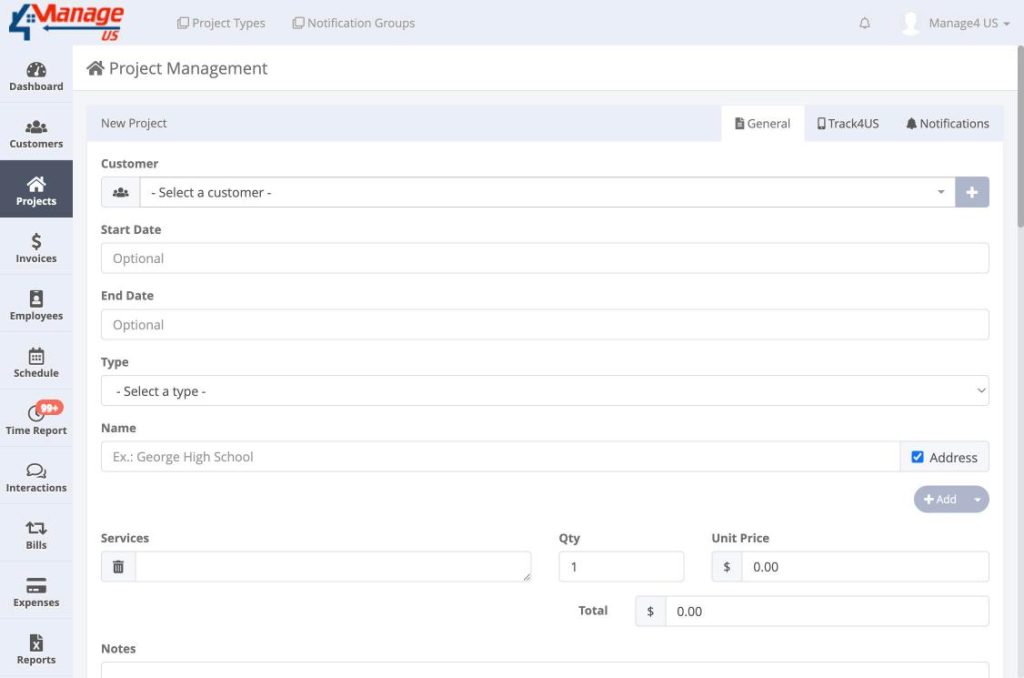
Using the left sidebar, select Projects to open the Project Management page. The New Project form is at the top of the screen.
Step 2: Fill In The New Project Form
Complete the following fields to create a new project:
- Customer (Required) – Select an existing customer from the dropdown. The customer must already be registered in the system. Error if missing: “The Customer field is required.”
- Type (Required) – Select the project type (e.g., Project, or any custom type your company has created). Error if missing: “Select a project type.”
- Name (Required) – Enter the project name or job site address. Error if missing: “The Name field is required.”
- Services (Required) – Add at least one service line with a Description, Qty, and Unit Price. Error if missing: “Service with missing description.”
- Total (Required) – The total must have a value (can be $0.00, but not blank). Error if missing: “The Total field is required.”
- Start Date / End Date (Optional) – Used for the dashboard calendar view. Leave blank if not needed.
- Notes (Optional) – Internal notes for the project.
Step 3: Understanding the Name / Address Field
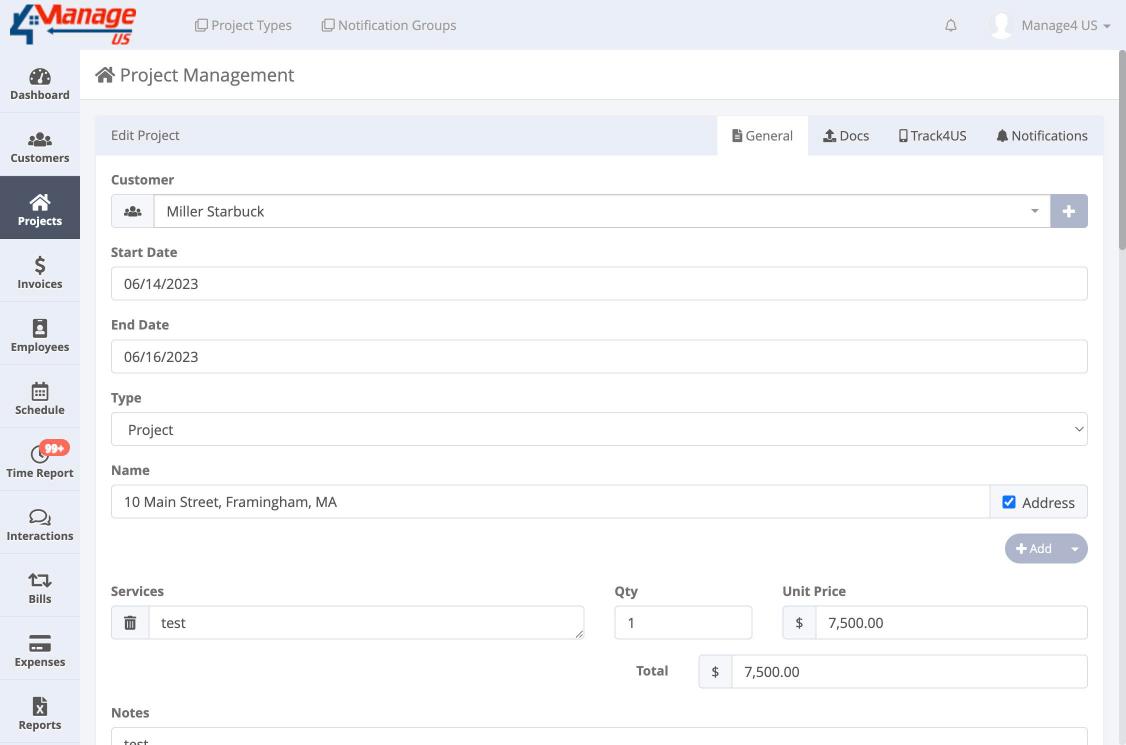
By default, the system treats the project name as a job site address — common for construction and field service businesses. If the project is not address-based, uncheck the Address checkbox next to the Name field and type any custom name you want.
Step 4: Adding Services
In the Services section, add one or more service lines each with a Description, Qty, and Unit Price. The Total updates automatically. To save time, click the dropdown arrow next to + Add and select My Services to insert pre-saved service lines from your company’s library.
Step 5: Save the Project
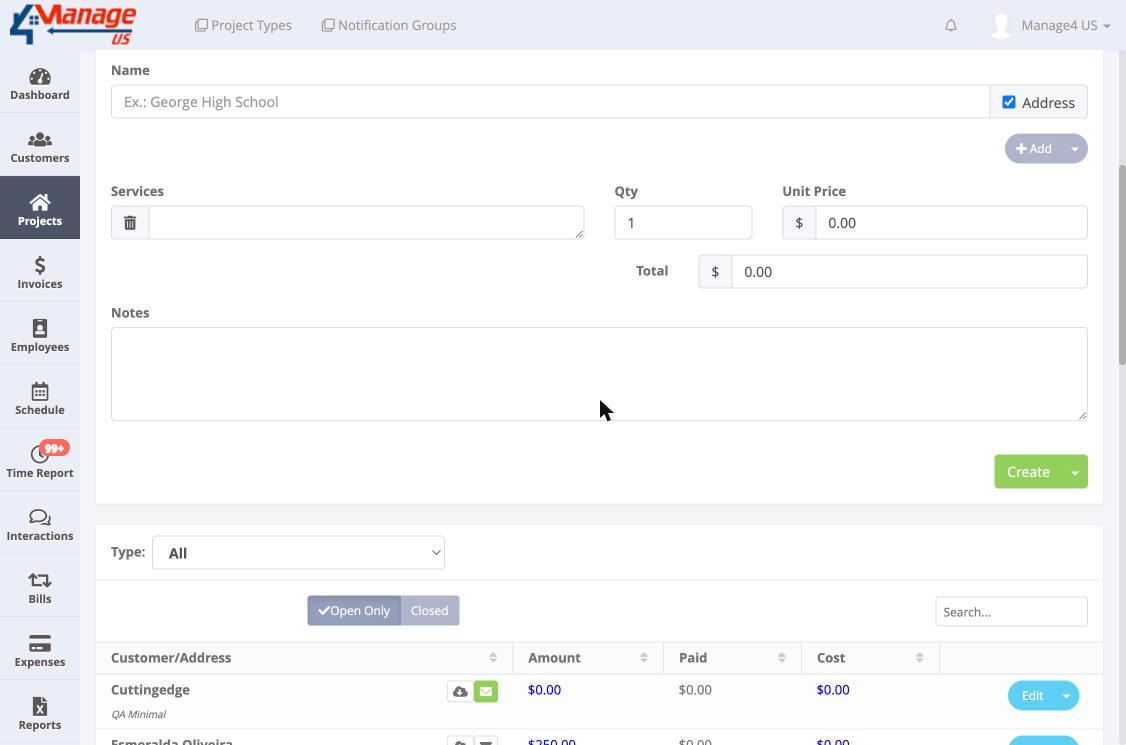
Once all required fields are complete, click the Create button. The project will be saved and appear immediately in the Projects list below.
2. Finding and Filtering Projects
The Projects list is located below the New Project form. It shows all active projects with columns for Customer/Address, Amount, Paid, and Cost. Use the following tools to find what you need:
- Search box – Filter projects in real time by typing part of the customer name or address.
- Type filter – Use the Type: All dropdown to filter projects by type (e.g., show only “Project” types or a specific custom type).
- Open Only / Closed toggle – Switch between active (open) projects and projects that have been closed. Closed projects cannot be reopened.
3. Updating An Existing Project
Step 1: Open Edit Mode
In the Projects list, click the Edit button on the project row you want to modify. The form will open with the current data pre-filled.
Step 2: Make Your Changes
Update any fields as needed — customer, type, name, services, pricing, dates, or notes. You can add as many services as needed; the project must always have at least one. The same required fields from creation apply when saving.
Step 3: Save, Close, or Delete
Click Save to persist your changes, Close to mark the project as closed, or Delete to permanently remove it. Closing a project is also triggered automatically when all linked invoices are marked Closed and their sum equals the project Total.
Important: Closed projects cannot be reopened.
4. Converting a Proposal Into a Project
When a customer accepts a proposal, you can convert it into a schedulable Project directly from the edit form:
- Scroll down to the Proposals section at the bottom of the Projects page and click Edit on the proposal.
- Change the Type field from Proposal to Project.
- Click Save.
- After the page refreshes, the record disappears from the Proposals list and appears in the Projects list — it is now schedulable.
5. Emailing a Project to Your Customer
In the Projects list, click the email icon (green envelope) beside a project to open the Send Project/Proposal by email modal. You can confirm or change the recipient, add extra comma-separated email addresses, write an optional message, attach a document (managed in Company Settings), and choose whether to send a copy to yourself (BCC). Then click Send.
6. Downloading a Project as PDF
Click the download icon (cloud with arrow) beside any project in the list to generate and download its PDF. This is the same PDF that is sent when you use the email feature.
7. Viewing Invoices Linked to a Project
To see which invoices are linked to (and paying) a specific project, click the Paid amount link in the Projects list for that project. A modal opens showing the List of Invoices for that project. If no invoices exist yet, it shows: “There is no invoice for this project yet.” Click Close to dismiss the modal.
8. Checking the Cost Breakdown
Click the Cost link (shown in blue) in the Projects list to open the Cost Viewer for that project. The Cost Viewer breaks down all money spent on the project into three categories:
- Labor – Cost based on employee work performed via the Schedule page.
- Subcontractor – Amounts paid to subcontractors.
- Expenses – Daily expenses associated with the project.
The Cost Viewer also shows the project name, customer, total amount, and a frequency selector (None / Monthly) to adjust how costs are displayed. If there are no records for a tab, it shows a message such as “There is no labor attached to this project.”
9. Viewing Project Interactions
To see a timeline/history of events for a specific project, click the dropdown arrow next to the Edit button in the Projects list and select Interactions. This opens the Interactions view for that project, showing:
- User events – Emails sent, amount updates, and other user-triggered actions.
- System events – Status changes and other automatically generated entries.
10. Closing a Project
A project can be closed in two ways:
- Manually – Open the project by clicking Edit, then click the Close button.
- Automatically – When all invoices linked to the project are marked Closed and their combined total equals the project’s Total amount, the project is automatically closed.
Once closed, a project moves to the Closed tab in the Projects list (use the Open Only / Closed toggle to view it). Closed projects cannot be reopened.